Showing posts with label physics. Show all posts

Friday, June 1, 2012

Confirming Expectations


A good experiment definitively distinguishes between alternative hypotheses. But things get tricky when a well established standard view is pitted against ill-defined alternatives.

My Focus story today describes measurements of density fluctuations in ultra-cold gases. Several experimental groups have been capturing and cooling bunches of about a thousand atoms above "atom chips" to study such things as Bose-Einstein condensates. In this case, Julien Armijo, a former member of a group at the Insitute d'Optique in Palaiseau, attributes some of the density fluctuation to quantum zero-point excitation of sound waves in the atomic cloud.

For an isolated oscillator, the signature of zero-point motion is conceptually straightforward: below a certain temperature the motions no longer decrease with temperature. What's left are the intrinsic quantum-mechanical oscillations, and the freezing temperature corresponds to the minimum quantum of energy needed to excite the oscillator. The obvious "null hypothesis" to be excluded would therefore be that the fluctuations continue to decrease toward zero with further cooling.

For the atomic cloud, however, the situation is much more subtle, because the sound waves have a continuous spectrum that extends to zero energy. This means that there are always some waves--the ones with the longest wavelength--that are excited no matter how low the temperature.

A further complication is that different wavelengths vary in their effect on the density fluctuations. A sophisticated theory says that the quantum contribution from the longest wavelengths does not add to the density fluctuations at all. In fact, this theory says that, at very long wavelengths, the fluctuations go away at zero temperature--exactly what one would expect if there were no quantum fluctuations!

As it turns out, though, the experiment measures fluctuations in individual pixels that are a few microns on a side, which corresponds to including waves with wavelengths on the same scale. The theory says that these waves will cause a measurable density fluctuation even at zero temperature.

But the same theory says that at nonzero temperatures, including shorter wavelengths will decrease the contribution of thermal excitations by exactly the same amount. The two terms get bigger as the pixels get smaller, but since they cancel anyway that doesn't affect the prediction.

This is messier than just looking for fluctuations that don't freeze out, isn't it?

It's rather difficult to choose a good null hypothesis where there are no zero-point motions. After all, everyone believes that, physically, the quantum fluctuations should be there, although different theoretical treatments may make slightly different predictions. So there is no particularly obvious way to choose a model where the quantum fluctuations are absent.

Armijo measures fluctuations that don't change with effective pixel size, just as the complete theory predicts. Of course, the measurements also agree with a theory that omits the size dependence of both the quantum and the thermal contributions. What they don't agree with, he emphasizes, is a model that includes only the thermal corrections, since these are no longer cancelled by the quantum term. It's not clear that anyone thinks this would be a credible model that needs to be excluded. (Setting Plank's constant to zero, a common way to "turn off" quantum effects, seems to make both corrections go away.)

What is clear is that the claim that this is a "direct observation of quantum phonon fluctuations" needs to be parsed quite carefully.

Monday, April 5, 2010

Changing the Rules

Is the Large Hadron Collider a time machine?

Although I usually like Dennis Overbye's physics writing for the New York Times, I thought he misfired in answering this question yesterday, in the general-audience "Week in Review" section.

In a Q&A entitled A Primer on the Great Proton Smashup that discussed the scientific ideas that underlie research at the LHC, Overbye addressed the question:

"What does it mean to say that the collider will allow physicists to go back to the Big Bang? Is the collider a time machine?"

It may seem silly, but it's actually a good question, since I'd bet a lot of people get confused by the metaphors that writers use to motivate the research. These metaphors get repeated often enough that they are almost cliché, but, as with all metaphors, it's important to know which parts to take seriously and which parts are more poetic or even misleading. Not everybody will know which is which, and it's good to explain it every so often.

Here's Overbye's complete answer:

"Physicists suspect that the laws of physics evolved as the universe cooled from billions or trillions of degrees in the first moments of the Big Bang to superfrigid temperatures today (3 degrees Kelvin) — the way water changes from steam to liquid to ice as temperatures decline. As the universe cooled, physicists suspect, everything became more complicated. Particles and forces once indistinguishable developed their own identities, the way Spanish, French and Italian diverged from the original Latin.

By crashing together subatomic particles — protons — physicists create little fireballs that revisit the conditions of these earlier times and see what might have gone on back then, sort of like the scientists in Jurassic Park reincarnating dinosaurs."

I'll discuss in a moment what I think Overbye means by "the laws of physics evolved," but this notion is awfully subtle for a general reader. More importantly, it completely undercuts the whole thrust of the question: physicists believe they are learning about the early universe in high-energy particle collisions precisely because the laws of physics are the same. If the laws are the same, we can create the same conditions (mostly temperature) to learn about what might have happened in the early universe. (He eventually does say that.)

The confusion comes because the phrase "the laws of physics" can be mean quite different things.

In the context of LHC, it seems clear to me that we refer to the behavior at the deepest levels of the universe. These rules don't get repealed overnight.

In fact, as I understand the phrase, it refers not to the current human description of events, which changes as we learn more, but to the "truth," which doesn't. Otherwise, it wouldn't make sense to say that we want to learn about the laws of physics from the collider (since we already know the laws, even if they're wrong).

Still, we often say the laws of physics say that something is impossible. In that context, the phrase can only refer to our current understanding of the laws, as best as we can discern them.

In fact, when we talk about the laws of physics we're frequently not talking about the deep levels probed by the LHC. Instead, we're referring to laws that describe the more mundane behavior of objects in our cold everyday reality.

In one sense, these "laws" are just a manifestation of the deeper laws. Describing the world in terms of protons, or nuclei, or atoms, or molecules, or cells, or organs, or organisms, or societies, is often vastly more useful than describing it with quarks or strings.

In some cases, the higher-level description can be mathematically related to the deeper description, for example by "coarse graining" the description to smooth out fine details.

This is the sense in which we can say that the "laws of physics" evolve: when the universe was very hot, the description had to include a lot of ingredients that are no longer important now that the universe is much cooler. We can now accurately describe things using a simplified description that doesn't have to include the messier details. The "laws" are different now.

This is Overbye's answer. But I think it will confuse people, since the goal of the LHC is to learn about the immutable laws, not the simpler descriptions or approximations.

One further, mind-blowing complication. Many cosmologists are exploring the possibility that our universe is just one of an infinite number of universes that formed, like bubbles, out of a larger multiverse. According to this view, the "laws of physics" --perhaps even the dimension of space--may be entirely different in each of these universes.

Even if we will always see the laws of physics as unchanging, they may be not be the same everywhere.


Wednesday, March 31, 2010

Picturing Quantum Mechanics

They say a picture is worth a thousand words. But what if those words are wrong?


Very cool recent experiments demonstrated a chemical reaction between molecules below a millionth of a degree (in Science, subscription required). My latest story for Physical Review Focus describes theoretical modeling of this reaction. We accompanied the story with this picture from the news release issued by the Joint Quantum Institute (a partnership between the National Institute of Standards and Technology and the University of Maryland), where the work was done.

It's a pretty picture, with its superhero color scheme and all, and it satisfies our need to avoid a solid block of text. But although it might not be a bad illustration of a room-temperature chemical reaction, it distorts much of what makes these ultra-low-temperature reactions special.

It's clear in the picture that two diatomic molecules are approaching each other, with dramatic consequences in store. The details of how the artist represents the bonds connecting a potassium and a rubidium atom in each molecule don't bother me too much. It doesn't match either of the customary representations, which are ball-and-stick models and the more accurate space-filling models, but there's no perfect way to represent something that can never be seen with visible light. Of course everyone knows that potassium atoms are green, but we'll let that slide, too.

The really problematic part of this picture is very difficult to avoid: the molecules really aren't anywhere, in the sense the picture conveys.

As first shown by experiments at Bell Labs in 1927, matter acts as waves as well as particles. At temperatures below a millionth of a degree, the relevant wavelength for these molecules is hundreds of nanometers, which is much, much larger than the separation of molecules shown in the experiment. There is no meaning to saying that these molecules are separated by such a short distance. They are simultaneously close and far away.

One way to think about this is to invoke Heisenberg's uncertainty principle. According to this principle, if you know an object's momentum with very high precision, you can't, even in principle, know its position very accurately. For these ultracold molecules, the momentum is almost zero, with very high precision, so you can only know where it is to the nearest hundreds of nanometers.

There's a second problem, too. The picture shows the molecules with particular orientations in space. That may not seem strange, but the molecules in the experiment were prepared in the rotational "ground state," with the lowest possible energy. Like the s-orbitals of electrons in a hydrogen atom, this state is spherically symmetrical. This means that the molecule is equally likely to be pointing in any direction. This isn't the same thing as saying we don't know what direction it's pointing (even though it does). Quantum mechanics says that it has no direction, at least until an experiment requires it to.

So the reacting molecules really aren't at any particular distance from one another, and they don't have any particular orientation relative to each other. That's one of the things that makes this chemical reaction--and the theoretical description of it--so interesting.

But good luck drawing that.


Monday, March 1, 2010

Survival of the Most Entangled

Most people think quantum-mechanics affects only atomic-sized objects, but many experiments have shown that it applies over many miles. In an experiment last year, for example, researchers sent pairs of light particles, or photons, between two of the Canary Islands off the coast of Africa, a distance of 144 kilometers.


This picture dimly shows La Palma, where the photons started, as seen from Tenerife, where they were detected.

Although the Austrian team, led by Anton Zeilinger, only detected one in a million of the pairs they sent, they found that these pairs retained the critical property of entanglement. This means that results of measurements on the two particles are related in ways that can't be explained if each particle responds to the measurement independently: the pair acts like a single quantum-mechanical entity. Such pairs can be used to securely transmit information over long distances.

My latest story at Physical Review Focus describes a theoretical analysis of this experiment by researchers in Ukraine and Germany. They suggest that the pairs that survive the half-millisecond trip must have had unusually smooth sailing through the turbulent atmosphere, and that this is part of the reason why they are still entangled. (The motion of the air, like the shimmering of a mirage in the desert, generally disrupts the light transmission, but there are short moments of clarity.) This is a pretty comprehensible idea, so in the story I was able to sidestep a lot of interesting issues about how the entanglement was measured and what it means.

For example, the experimenters delayed one photon by about 50 ns by passing it through a fiber before sending it after the other one. That's not a long time, so the atmospheric conditions probably looked pretty similar to the two photons. Since they were subjected to much the same conditions, it doesn't seem so surprising that they would remain entangled. In fact, the original experimenters were pretty pleased that it all worked, but clearly they were hoping it might or they wouldn't have gone to the trouble.

Sending the two photons on the same path certainly isn't the most demanding task, either. More impressive would be sending them on different routes to a final destination where they were compared. But sending an entangled pair is good enough for some quantum communication schemes.

What made the paper particularly interesting was the conclusion that the turbulent atmosphere would be better than, say, an optical fiber that had the same average loss, because the fiber's properties wouldn't change with time. Zeilinger expressed pleasant surprise that the rare moments of exceptional clarity would more than make up for the times when the atmosphere was worse than usual. Still, having no turbulence at all (or a very clear fiber) would be even better.

Exploiting quantum mechanics in secure long-distance communication, for example via satellites, looks more realistic than ever.

Monday, February 22, 2010

Stoner Magnetism

My latest story at Physical Review Focus describes experimental evidence that a missing atom in a chicken-wire-like sheet of carbon can hold a single extra electron.

Theorists have long expected this to be the case, and that unpaired electrons on such vacancies might join up to make an entire single-atom-thick graphene sheet magnetic at relatively high temperatures. Many researchers are excited about the rapid and unusual motion of electrons in these sheets, and IBM researchers recently described a graphene field-effect transistor, grown on silicon carbide, whose expected frequency (fT) exceeds 100GHz. If the layers are also magnetic at normal temperatures, this material could be fun and potentially practical for spintronics, which manipulates both the charge and magnetic properties of electrons.

The actually experiment didn't directly show magnetism, though, just a state that looked like it should hold only one electron. The researchers used scanning-tunneling microscopy to look at a clean, cold graphite surface, which includes many stacked graphene-like layers. In fact, the authors suggest that magnetism may exist in graphite, but not in graphene, because in the latter the effects of two equivalent carbon positions for a vacancy may cancel each other out.

It turns out to be a little bit tricky to explain the connection between local spins, which naturally carry a magnetic moment, and magnetism in a bulk material.

The usual story is straightforward: some types of atoms (or vacancies) naturally have a magnetic moment, "like a tiny bar magnet." Nearby moments exert forces that tend to align their neighbors, either the same way or oppositely. If it's the same, then the moments on many different atoms can all line up to form a net magnetization in a large sample, if the temperature is not so high that they get jostled out of position.

This description is correct--but only for some magnets.

For other magnets, it's just not accurate to say that the atoms each have magnetic moments that line up with each other. In these so-called "itinerant" magnets, the magnetization comes from the metallic electrons washing over all of the atoms. In this case, preference for one direction or another at a particular atom develops only as a part of the magnetization of the whole sample.

Mathematically, itinerant magnetism takes the form of an instability, in which the energy benefit of aligning the moments of the electrons overcomes the energy cost of doing so. A simple description was developed back in the 1940s by Edmund Stoner at the University of Leeds, and his name is still used to convey the ideas. (I apologize to anyone who expected this post to be about the natural charisma of pot-smokers.)

Of course, the distinction between the "local-moment" and "itinerant" magnetism is often somewhat fuzzy, and for the purpose of explanation to the general public it may not seem that important. But to people who understand the issues, getting it wrong is unforgivable, as I found out to my chagrin after using the above simple local picture in my Focus story on the 2007 Physics Nobel on Giant Magnetoresistance (GMR).

GMR read heads in disc drives can be seen as a simple type of spintronics device. In more sophisticated devices that people dream about, electrons will carry their magnetization to new locations, so it's important to be clear on the nature of that magnetism.

Thursday, February 4, 2010

Fractal Biology

I first learned about the intermediate-dimension objects called fractals in the late 1970s, from Marvin Gardner's wonderful "Mathematical Games" column in Scientific American. One of the cool and compelling things they can do is explain is how highly branched circulatory system, with an effective dimension between two and three, could have an effectively infinite surface area, abutting every cell in the body, while taking up only a fraction of the body volume.

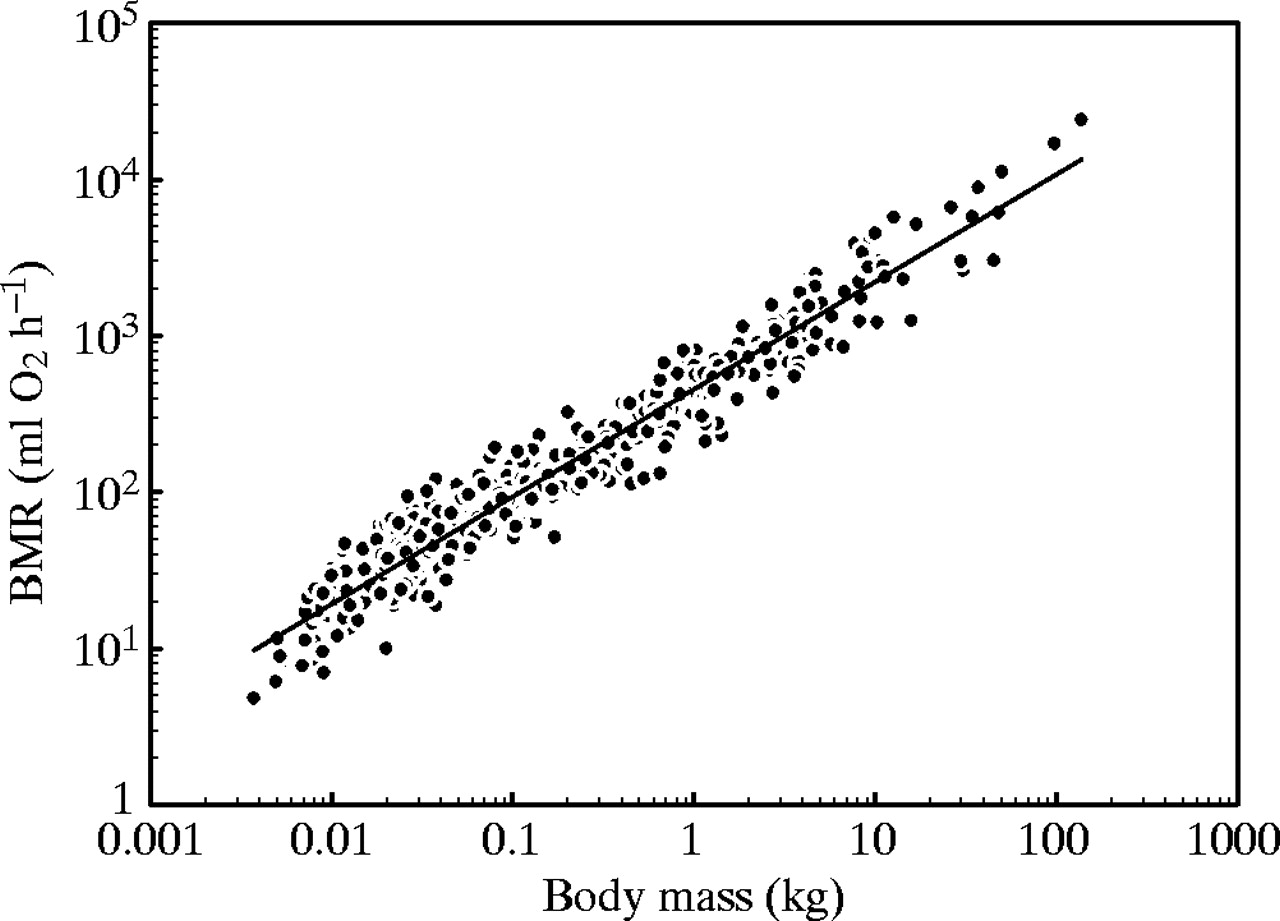
Twenty years later, Geoffrey West and his collaborators used this fractal model to explain the well known "3/4" law of metabolism, in which different organisms' resting metabolic rate varies as the 3/4 power of their body mass. West, an erstwhile theoretical physicist from Los Alamos who recently stepped down as the head of the delightfully eclectic Santa Fe Institute (for which I've done some writing), used similar scaling analyses of things for other aspects of biology as well as resource usage in cities.

Unfortunately, according to Peter Dodds at the University of Vermont, the well known 3/4 law is also wrong. In my latest story for Physical Review Focus, I briefly describe how Dodds uses a model of the branched network to derive an exponent of 2/3.

Interestingly, this 2/3 exponent is precisely what you'd expect from a simple computation of the surface to volume ration of any simple object. A 2/3 law for metabolism was first proposed in the mid 1800s, Dodds said, at "a tobacco factory in France, trying to figure out how much to feed their workers, based on their size. They asked some scientists and they said 'we think this 2/3 rule would make sense.'" Experimental data on dogs seemed to fit this idea.

But later experiments hinted at a slightly higher exponent. "At some point it became more concretely ¾," Dodds said, based on the work of Max Kleiber published in 1932. "He'd measured some things that looked like 0.75 to him. You know, he had nine or ten organisms, and it was easier on a slide rule." At a conference in the 1960s, scientists even voted to make 3/4 the official exponent.

But in the wake of the fractal ideas, Dodds and his collaborators re-examined the data in 2001. "What really amazed me was I went back and looked at the original data and it's not what people thought. People had sort of forgotten about it by that point." Instead, Dodds, found, the data really matched 2/3 better. At the very least, the 3/4 law was not definitive. This doesn't mean that the fractal description is not useful, only that it has a different connection to the metabolic rate.


From C.R. White and R.S. Seymour, Allometric scaling of mammalian metabolism, Journal of Experimental Biology 208, 1611-1619 (2005). BMR is resting metabolic rate. The best fit line has a slope (exponent) of 0.686±0.014 (95% CI), much more consistent with 2/3 than with 3/4.

Other authors have since supported this conclusion, especially if they omit big herbivores like kangaroos, rabbits, and shrews, whose resting metabolism is hard to measure. The real biological data is messy, and perhaps it is silly to expect a simple mathematical law to apply to diverse biological systems. In any case, the difference between the two exponents is modest, amounting to a factor of about 2.5 in metabolism over the range of experimental data in the plot.

Still, some experts, such as the commentators that I interviewed for the Focus story, still think that the 3/4 law is correct. But it seems plausible that many decades of experimental observations have been colored by researchers' expectations. Science remains a human endeavor.

Friday, January 29, 2010

Fusion on the Horizon?

When I arrived at MIT in 1976, fresh off the bus from Oklahoma, nuclear fusion looked like an exciting scientific career. The country was still reeling from "the" energy crisis (oil was over $50/barrel in today's prices!), and fusion was the energy source of the future.

It still is.

The promise has always been compelling, and is often described as "unlimited pollution-free energy from seawater." The fusing of two hydrogen nuclei to form a helium nucleus, releasing abundant energy without the radioactive products of nuclear fission, certainly seems cheap and clean. Indeed, this kind of process is the ultimate source of all solar energy as well, and the H-bomb showed that we can create it on earth.

So the challenges for fusion are not fundamental. They're "just engineering."

Foremost among these challenges is keeping the hydrogen nuclei together when they're heated to millions of degrees. This temperature is needed so they can overcome their natural electrical repulsion, but when they have a lot of energy they're just as likely to go in other directions. Sadly, techniques to confine these tiny nuclei seem to require tons and tons of expensive, high-tech equipment. Of course, advocates of cold fusion, now called "Low Energy Nuclear Reactions," think they don't have to solve this problem, but most scientists are unconvinced.

The traditional approach to fusion, then being pursued at MIT, involves confining a donut-shaped plasma of ultra-hot charged particles by using an enormous magnetic field. One problem is that the plasma finds all sorts of ways to wiggle out of the confinement. Over the decades, researchers have made steady progress in controlling these "instabilities." Recent research, still done at MIT and published online in Nature Physics this week, used a surprising technique of levitating a half-ton magnet in mid-air.

The other mainstream approach is to squeeze and heat hydrogen-containing materials by blasting a pellet with powerful lasers from all sides. Research at Lawrence Livermore's National Ignition Facility, published online in Science this week, showed promising results for this approach.

I've always found the idea of milking a steady stream of power out of occasional explosions inside of a horrendously expensive, delicate laser apparatus confusing. In fact, the long-defunct radical magazine Science for the Peoplepublished an article in 1981 claiming that "inertial confinement" fusion was just a plot by the military to test fusion explosions in the lab. That at least made sense.

The new results seem like steps forward for both approaches, but there's a long way to go. For one thing, neither group actually fused anything. They just set up conditions that seemed promising.

The reality is that no researchers want to actually use fusion-capable fuel in their machines, because it would make them radioactive (the machines, not the researchers). This may sound surprising, since fusion is supposed to be so clean. But although fusion doesn't produce radioactive nuclei, it does make a whole lot of high-speed neutrons. To generate power, researchers would need schemes to extract the energy from these neutrons. But the neutrons also irradiate everything in sight, turning much of the apparatus into hazardous waste, which would make experiments much harder.

But if the researchers keep making progress, they're going to have to use the real stuff soon. They'll look for any fusion at all, and eventually for "scientific breakeven," where they get more energy out than they use to power all the equipment. "Commercial breakeven," where the whole endeavor makes money, is much further down the road.

I wish the researchers good luck; they may yet save our planet. But I'm also glad I didn't decide to spend the last third of a century working on fusion.

Tuesday, January 12, 2010

Anniversary of Hopping Paper

Thursday, January 14, 2010 is the 25th anniversary of one of my first scientific papers, Hopping in Exponential Band Tails, in Physical Review Letters. It came out just as I arrived at Bell Labs.

It still surprises me that this paper has gotten nearly 200 citations, and that they continue to dribble in even now. Most papers are surpassed by new developments within a few years of publication. In this case, I stumbled on a useful but very accessible concept that people can easily wrap their head around. But I'd guess that most people that cite it have never read it.

The paper concerns motion of electrons in amorphous semiconductors, that is, semiconductors without a crystalline lattice. The best known example is the amorphous silicon alloys that are used for cheap solar cells.

Until the 1960s, some physicists questioned whether amorphous semiconductors could even exist (although they clearly did), because the quantum-mechanical understanding of semiconductors depended on the mathematical properties of wavelike electrons moving among the regularly-spaced atoms in a crystal. For electrons in some range of energies, the electron waves that diffract from the atoms destructively interfere, creating a bandgap with no electron states. At other energies, where there are electron states, they extend through the entire crystal. None of this mathematical framework for understanding semiconductors seemed to work unless the atoms were arranged in a regular crystal.

Phil Anderson, then at Bell Labs, showed in 1958 that if atoms were arranged in an irregular pattern, electronic states could exist, but be localized near particular atoms. Neville Mott and others suggested that in an amorphous semiconductors, electrons would be localized over some range of energies but extend infinite distances at higher or lower energies. The energies that separated the localized and extended states, which have the character of a phase transition, were called "mobility edges." If one conceptually replaces the band gap of crystalline semiconductors with the gap between mobility edges, then the mathematical treatment of amorphous semiconductors looks very familiar. Anderson and Mott shared the 1977 Physics Nobel with John van Vleck for their discoveries. Instead of being denigrated as "dirt physics," disorder is now a perennial topic in condensed matter physics

In Mark Kastner's group at MIT, we were studying what happened to optically generated electrons in the "band tails": the localized states near the mobility edge, whose number decreases exponentially into the gap. Based on some experiments I had done, I proposed that, at low temperatures, electrons would at first simply "hop" from one localized state to another, avoiding the extended states at the mobility edge altogether. Later on, as they moved to energies where the states where farther and farther apart, they would find it faster to hop up to where there were more states--but not all the way back to the mobility edge.

I called the energy to which electrons hopped--and where they could move easily--the "transport energy," and used a simple model to calculate how this energy varies with temperature.

If once conceptually replaces the band gap of crystalline semiconductors with the gap between transport energies, then the mathematical treatment of amorphous semiconductors looks very familiar. There are some important differences, though. For example, a magnetic field has a different effect on hopping electrons than on those that are freely moving. But although some details are different, the overall picture of amorphous semiconductors looks much like the pictures used by electrical engineers.

At the time, I was concerned that people would only remember Marc Kastner's name, so he graciously agreed to let me be sole author. I later regretted that selfishness, because anyone who knew Mark could see his style in it, and he certainly helped me to frame the ideas. Such are the follies of youth.

Monday, January 11, 2010

"World's First Molecular Transistor"


Overall electrode geometry, probably not for a device that was actually measured. Inset: Molecule-coated gold nanowire between the electrodes has developed a nanometer-scale gap because of electromigration, in which current pushes atoms away. White rectangle is 100nm long, for scale. Inset of inset: complete fantasy of what might happen in a small fraction of cases.

An interesting article in Nature, Observation of molecular orbital gating, got somewhat lost over the holidays, in spite of the breathless Yale University press release, Scientists create world's first molecular transistor.

Mark Reed of Yale and his colleagues made hundreds of small gold wires between large electrodes on a nominally 3nm-thick alumina insulator on a substrate and coated it with organic molecules. They then applied an electric current that pushed enough atoms out of the way to make a small gap in the wire. Near absolute zero, in a few of the wires, they then measured a current variation with source-drain voltage that looked like what they expected if the current was passing through a molecule close to the surface, whose energy they could change by applying a voltage to the substrate, or gate. In addition, to test whether the current was really going through the extra organic molecules, the researchers found sharp features in the current trace when the source-drain voltage brought the energy levels into alignment, in agreement with the molecules' "signature."

So far, so good. As the authors note, there have been previous observations of gated conduction in molecules before, but it's not easy to get two electrodes connected to a tiny molecule, let alone three.

But the press release says this shows that "a benzene molecule attached to gold contacts could behave just like a silicon transistor."

How does this fall short of that description? Let me count the ways.

No saturation. The current doesn't look at all like a normal silicon field-effect transistor (FET), where the gate voltage changes the channel resistance. Instead, the authors describe the conduction as tunneling between the two remaining pieces of the wire, while the gate voltage changes the precise energy levels in the molecule. The current is low near zero source-drain voltage and rises dramatically as the voltage increases. In contrast, the current in an ordinary FET rises linearly with voltage, like a resistor, and then saturates. In ordinary circuits, this saturation, corresponding to a voltage-independent current, is central to the transistor's gain, which gives it the ability to amplify power or to drive other transistors.

Low current. Tunneling conduction gives inherently low current levels. The currents observed are in the nanoamp range, a million or so times smaller than those in transistors on integrated circuits. This small current would take correspondingly longer to charge up any capacitor, so the circuits would be slow.

Large parasitic capacitance. Because the source and drain electrodes lie right on top of the gate, the actual capacitance is even bigger. Modern transistors are built with self-aligned processes that minimize the overlap capacitance.

Low gate coupling. The authors estimate that they need to put 4V on the gate to change the electron energies by 1V (25%). This is actually surprisingly good for a device like this, where multiplies of 0.1% are not unheard of. But it's still a problem. Silicon technologists work very hard to get perhaps 80-90% of the gate voltage to show up on the channel, and if it doesn't the device is very hard to turn off, resulting in excessive power. Moreover, if the energy isn't being controlled by the gate, it should be controlled by the drain, which means that it will never be possible to saturate the current to isolate the input from the output.

Packing Density. The entire device is much bigger than the molecule. From the micrograph, the electrodes are many microns in size. No doubt the electrodes could be made more compact, but to compete with integrated circuits they would have to be packed to separations comparable to their size, and this technique doesn't look like it could ever do that. No one really cares whether transistors are small. They care if they can be packed densely (and are cheap and fast and use little power).

Low Yield. The authors measured 35 devices that did what they hoped, out of 418 attempts, so about 8% of them worked. In contrast, in an integrated circuit only about 0.000001% of the transistors fail. (Or something like that--I don't have access to real numbers these days, but you get the idea.) Building a large circuit from occasionally-functional devices would require a completely new type of circuit design, and probably wouldn't be worth it.

This low yield is not surprising (or easily avoided), since the fabrication seems to demand that most of the current run through a molecule that is positioned right just at the gap and right at the corner where the wire meets the substrate, and that it not get blown away during the electromigration. Still, it is a matter of concern that devices are defined to be working if they do what the experimenters think they ought to do. This is a problem with many molecular fabrications schemes, and I give the team credit for doing the "inelastic tunneling spectroscopy" to verify the molecules have something to do with the current. But I would feel better if they gave an indication of how representative the devices they showed are.

The authors did a couple of other tests that I'm guessing didn't work as dramatically as they had hoped. First, they saw rather small differences between "insulating" molecules--fully saturated alkanes sandwiched between sulfur groups-- and "metallic" molecules--in which the organic "meat" of the sandwich is an aromatic benzene ring. Second, the voltage "fingerprints" of the molecules didn't shift when they applied the gate voltage, as one would naively have expected. The shapes and sizes of the peaks changed, but not their positions.

Overall, this is a nice research result, with some strong observations and some puzzling features. Some of my quibbles could be addressed in time, but it's not clear that these molecules will ever behave "just like a silicon transistor."

In 1997, Mark Reed was quoted to the effect that silicon technologists were "shaking in their boots" over his team's results. Those of us working in silicon technology at the time got a good laugh out of that claim, and went back to work. The new press release says that "Reed stressed that this is strictly a scientific breakthrough and that practical applications such as smaller and faster 'molecular computers'—if possible at all—are many decades away. 'We're not about to create the next generation of integrated circuits,' he said."

He's got that right.

Tuesday, December 29, 2009

Salting out and in


My latest story for Physical Review Focus concerns calculations of the tendency of various ions dissolved in water to accumulate at its surface.

This is a really old problem, discussed by some of the giants of physical chemistry. In the 1930s, for example, later Nobel winner Lars Onsager and others suggested that the termination of the electrical polarization at the surface of the water would give rise to an "image charge"--a surface charge of the same sign as the ion that creates an electric field just like that of a point charge at the mirror-image location on the other side of the interface. The repulsion from this image charge, they suggested, would keep ions away from the surface.

People have apparently suspected for decades that things can't be that simple, because different ions alter the surface tension to different degrees, indicating that they are changing the energy of the surface, presumably by being part of it. But only in the past decade or so have new experiments and simulations shown that some simple negative ions like halogens can be stable at the surface. Such ions at the surface of atmospheric droplets could be important catalysts, for example for breaking down ozone.

The two closely related Physical Review Letters that motivated the Focus story attribute the attractiveness of the surface position of a large negative ion to its internal polarizability. The internal rearrangement of charge, they say, allows the ion to retain much of the electrostatic attraction to nearby water molecules without creating a big hole in the water. However, I talked to another researcher who attributes the stabilization of the surface ion to a distortion it induces in the shape of the nearby surface. These both seem like potentially important effects, and both may play a role in the ultimate understanding.

The difference between the two could be important, though, for a related and even older phenomenon: the effect of various added salts on dissolved proteins. In 1888, Hofmeister ranked a series of ions in terms of their effectiveness in precipitating the proteins, and the order of the series mirrors that which was later found for the effects of ions on surface tension.

"Salting out" occurs when an added salt reduces the solubility of a protein, presumably by tying up water molecules and raising its effective concentration. This effect has been used for decades to create the protein crystals needed for structural studies like x-ray crystallography.

In contrast, "salting in" makes the protein more soluble, but may denature it. Salts that have this effect may alter the repulsion between water and the hydrophobic regions of the protein. This repulsion is critical for maintaining the shape of proteins that naturally occur in the bulk of the cell, since that shape generally presents hydrophilic regions to the solution and shelters hydrophobic regions inside. (Proteins that naturally occur in membranes, by contrast, generally expose a hydrophobic stripe where they are embedded in the non-aqueous center of the membrane sheet.)

The polarizability of ions at the protein-water interface could have an important effect on this repulsion. In contrast, since the water-protein interface is entirely within the liquid, changing the shape of the interface wouldn't seem to be an option.

It is true that many proteins take on their final shapes only in the presences of "chaperone" proteins, which can also help fix them up if they become denatured. Nonetheless, any insight into the interactions between water and proteins could be very important to understanding why they fold the way they do, and how circumstances might change that folding.

Sunday, November 22, 2009

Rules or Consequences

Can we learn about one phenomenon by studying a completely different one?

Putative "laboratory versions" of exotic phenomena appear regularly in the news, such as microwave analogs of "rogue" ocean waves, optical-fiber analogs of rogue waves and black holes, and, as I've discussed here, magnetic-crystal analogs of magnetic monopoles.

But not all of these experiments are equally illuminating. Researchers, and journalists who write about them, need to think clearly about how the two systems are related, and what's missing. Experiments on a model system can show what behavior arises from shared underlying rules, and how that behavior changes as conditions change. But only experiments on the original system can test whether those rules are relevant.

The results of known mathematical rules aren't always obvious. Even Newton's second law, which relates the force on an object to its acceleration, only stipulates a differential equation that researchers must solve to find how an objects position changes with time. When the force is constant, this is easy: the position follows a parabolic course in time.

For more complicated situations, scientists often can't relate the rules to the end result. In some cases they turn to simulations, which can be regarded as a model system that, ideally, embodies the mathematical rules perfectly. But simulations are often restricted to unrealistically small systems that could behave differently than the real McCoy.

In these cases, researchers can learn from actual systems that--they think--follow similar rules. For one thing, this may make precision measurements easier. Placing a block on an inclined plane, for example, slows down its acceleration due to gravity, making it possible to test the parabolic law more precisely.

Unfortunately, the model system may introduce complications of its own. The friction on a sliding block is significantly different than that air friction on a falling body--for example it's much larger before the block starts to move. Even though the rules of gravitational force are the same, the differences may completely obscure the relationship between the two systems. Researchers must then spend a lot of energy tracking down these differences.

But to draw any parallel between two systems, researchers must establish that both are governed by similar rules. Unless they know that, seeing a particular behavior in a model system, by itself, is irrelevant for deciding if the original system follows the same rules. The way to test that--but not prove it--is to do experiments on that system, and see if the behavior is similar.

In our example, if an object follows a parabolic time course, it might well be that it is responding to a constant force. (Of course, it may just be moving through curved spacetime.) With luck, the model system--the inclined plane--would have demonstrated something close to this parabolic result, even if the equations had been unsolvable. The model system then hints at a similarity of the governing rules.

Similarly, a chaotic microwave cavity or an optical fiber might show a "long tail" in the distribution of wave heights that mathematically resembles that which is experimentally measured on the ocean, and which occasionally spawns mammoth rogue waves. Because it's easier to vary the conditions in the laboratory, these experiments might also show what aspects of wave propagation are relevant to rogue-wave formation. In these systems, researchers already understand the basic features of wave propagation--the question is what happens when they combine the ingredients in various ways.

In contrast, physicists do not know whether the basic equations of physics allow magnetic monopoles. Some grand unified theories predict them, but they've never been seen in free space, despite extensive experiments. The observation of monopole excitations at low temperatures in magnetic materials called spin ices has absolutely no implications for the nature of the fundamental equations. It may be that it helps to understand how "real" monopoles would behave, if they exist. But it says nothing about whether they do.

Model systems can reveal important relationships between models and behavior. They can also uncover real-world complications that need to be included to make models more relevant. But to find out whether a model applies to a particular system in the first place, researchers need experiments on that system. Experiments on a model system aren't enough.


Tuesday, November 10, 2009

Free Will and Quantum Mechanics

[NOTE: This piece is modified from one written in the spring of 2005, but never published because it was too demanding, so be warned.]

In 2004, two mathematics professors from Princeton University devised the simplest proof yet that the world really is unpredictable at a microscopic level.

Quantum mechanics has passed many experimental tests, but it generally predicts only the probabilities of various outcomes. Over the decades, many physicists, notably Einstein, have longed for a description that doesn't involve "throwing dice."

The Princeton "Free-Will Theorem" concludes that, if experimenters can make choices freely, then this unpredictable behavior of elementary particles is unavoidable. But other experts suspect that the result is another manifestation of the "spooky action at a distance," that dominates the quantum world.

"Physicists usually are not impressed much," admitted John Horton Conway, the inventor of the 1970 cellular-automaton game he called Life. "They actually believe quantum mechanics." Indeed, few dispute that quantum mechanics gives correct predictions. But Conway and his colleague Simon Kochen said that although their conclusions are familiar, they start with three axioms, called SPIN, TWIN, and FIN, that are much simpler than previous theorems, and avoid "counterfactual" experiments that can't be done.

The first axiom, called SPIN, is based on an unusual property of a "spin-one" elementary particle: Measuring the square of its angular momentum, or spin, as projected along three perpendicular directions will always yield two ones and one zero. This bizarre property is usually derived from quantum mechanics, but it could have been observed independently.

"We don't have to know what 'the square of the spin' means," Conway said. "It's really rather important that we don't, because the concept 'squared spin' that we're asking about doesn't exist-- that's one of the things that's proved."

If such a squared spin existed, then experimenters could, in principle, choose a direction to measure it along and know in advance whether it would be one or zero. But in a groundbreaking theorem published in 1967, Kochen and E.P. Specker showed that it is impossible to prepare a list beforehand that gives the required two ones and a zero for all possible sets of measurement directions. They concluded that there are no "hidden variables" that describe the "real" spin.

Later researchers, however, realized that such hidden variables could logically exist, but only if their values changed depending on which measurements were chosen, a property known as "contextuality."

To avoid this problem, Conway and Kochen analyzed pairs of particles with matched properties. Their second axiom, which they call TWIN, is that experimenters can make and separate such pairs. This ability is well established, and experiments on the pairs have confirmed the quantum prediction that measurements of their properties remain correlated long after they separate. (I described one recent experiment for Technology Review.)

In 1964, John Bell showed that the some measurements on the two particles can only be explained if each particle somehow continues to be affected by the other, even though they are far apart. This surprising "nonlocality" has since been confirmed in numerous experiments, which find that the correlation, averaged over many pairs, exceeds the maximum for any conceivable local theory.

To avoid the need for statistical averages, Conway and Kochen applied the Kochen-Specker theorem to a single, matched, spin-one pair. If researchers measure the same component of the squared spin for both particles, they should always find either both zeroes or both ones. (Rutgers student Douglas Hemmick also derived this result in his 1996 doctoral thesis.) A similar "Bell's theorem without inequalities" was described in 1989 by Daniel Greenberger, Michael Horne, and Anton Zeilinger, using three "spin-1/2" particles.

Conway and Kochen's third axiom, FIN, is grounded in special relativity, and says that information travels no faster than, say, the speed of light. In spite of appearances, they say, nonlocal effects do not exceed this speed limit, because they describe only coincidence between two measurements, not causation. In fact, special relativity makes it meaningless to say that either of two widely separated measurements occurred "first," so it makes no sense to talk of information passing between the two.

Combining these ingredients, Conway and Kochen imagine that the squared spin is measured in all three directions for one member of a pair. If an experimenter measures the spin of the other member along any of these directions, the result must agree with the one for the first member.

But if the experimenter is free to choose which direction to measure, then because of FIN, that information is not available to the first particle. The result of the first measurement can't depend on her choice, but since there is no way to consistently anticipate all possible measurements, Conway and Kochen conclude that no hidden variable could have predicted the outcome. The only way to avoid this unpredictability, they say, is if the experimenter wasn't really free to choose which experiment to do.

Tim Maudlin, who heard Conway present the work in a colloquium in November 2004, disputes that conclusion. A philosophy professor at Rutgers University and author of "Quantum Non-Locality & Relativity," Maudlin remarked that saying the behavior of a particle cannot be determined by information in its own past "is just what we mean by non-locality," which is already clearly established. "You've taken the contextuality and stretched it out" to include both members of the pair, he asserts.

Conway and Kochen published their Free Will Theorem in 2008, and the Princeton Alumni Weekly has posted videos of lectures by Conway. But it appears that other scientists are free to choose whether to believe it.

Friday, October 30, 2009

Conductance is Transmission

My latest story in Physical Review Focus describes measurements of electrical conduction between two "buckyballs," or C60
molecules. This sort of characterization is a prerequisite for the sort of understanding and control that would be needed for future "molecular electronics."

The electrical conductance (the inverse of the resistance) in such tiny systems is limited to values of the order of 2e2/h, where e is the electron charge and h is Planck's constant, which sets the scale for quantum phenomena. This combination goes by the name of "conductance quantum," or G0.

Unlike other quanta like photons, however, the conductance is often not generally required to come in discrete packets. Under special experimental circumstances, however, such as in "quantum point contacts," the conductance can take on reasonably stable values that are simple multiples of G0.

Still, the idea that conductance has special value was quite jarring when it became popular in the 1980s. Most materials have a well-defined conductivity determined by number of electrons and how frequently they scatter from imperfections of atomic motion. The conductance, which is just the total current divided by the voltage, is then calculated from the conductivity by multiplying by the cross-sectional area of a piece of material, and dividing by its length.

In very small devices, however, electrons move as a wave from one end to the other. The conductance is then determined by the likelihood that they propagate to the far end. The visionary IBM researcher Rolf Landauer laid the groundwork for this view in a 1957 article in the IBM Journal of Research and Development.

Only a quarter-century later in the 1980s, however, did experiments start to catch up. Researchers had been doing experiments at very low temperatures in clean semiconductor systems, where the electrons propagate cleanly as waves over many microns. Lithographic patterning can easily create structures that are smaller than this distance, and comparable to the wavelength of the electrons themselves (typically a few hundred angstroms, or a few hundredths of a micron).

In the semiconductor samples, electrons are free to flow only in a thin sheet near the surface. Researchers can apply a voltage a metal film on top of a semiconductor so that the electrons have to avoid the region under the metal. If there is a small gap in a line of metal, electrons can squeeze through this quantum point contact between them. This is the situation where the quantum effects become important.

The usual derivation goes like this (feel free to skip over this long paragraph): on the two sides, electrons fill up the available states equally, so filled states on one side face filled states on the other and have no way to move across. Applying a voltage V raises the energy of electrons on one side, so the top ones now face empty states on the other. The number of such exposed states is the energy change, eV, times the number of states in each energy interval. Here's the magic: the number of states, for the special case where they are one dimensional waves, is determined by how their energy E varies with wave vector k: dE/dk. Their group velocity--the rate at which they impinge on the contact--is (1/h) times dk/dE. Each carries a charge of e, and there are two electrons in each state because there are two spin states. Presto: the total current is eV(dE/dk)(1/h)(dk/dE)2e = 2e2/h x V.

To me it's rather unsatisfying to go through these shenanigans to get a simple answer like 2e2/h. It doesn't seem right that we have to introduce all these extra quantities just to have them cancel out. Is there an easier way to get to this answer?

In any case, it is now clearly established that each quantum state has an overall conductance of G0=2e2/h, multiplied by the transmission coefficient, which is the probability of a particular wavelike electron making it to the other side. This result applies to any quantum transmission, whether it's in an engineered semiconductor or a single C60 molecule.

Sunday, October 25, 2009

Reliability

A light bulb, floating over someone's head, has become a universal icon for a flash of insight. But the history of the incandescent bulb also shows that a good idea is not enough. The success of a new gadget often hinges on its ability to survive the rigors of the real world.

An electric current causes many materials to glow…momentarily. Glowing is a natural consequence of the "red-hot" temperatures produced by the current. But another consequence is reaction with oxygen in the air that promptly burns up the would-be filament. Protecting it in an air-free glass bulb is a key step toward practical electric light.

The filament material is also critical. The recently reopened Thomas Edison National Historical Site in West Orange, New Jersey recounts Edison's 1870s search through thousands of candidates, many involving carbonized threads of various sorts, including exotic materials like bamboo. Much of this selection process aimed at increasing the lifetime beyond the 15 or so hours of the first "successes." (British inventor Joseph Swan devised a similar device in Britain around the same time.)

Some 25 years later, Hungarian and Croatian inventors introduced the tungsten filaments like those we we use today, which last longer while providing more light.

The tungsten-halogen lamp extends the improvement. Its white-hot filament delivers much more light in the visible part of the spectrum, but over time even tungsten evaporates at these temperatures. Small amounts of halogens like iodine or bromine in the bulb react with the evaporated tungsten. The resulting halide migrates back to the filament where the heat decomposes it, leaving the tungsten back where it started, while the halogen goes on to pick up other stray atoms of tungsten. The result is a brighter, more efficient bulb.

Situations like this, where performance is directly improved by increasing the lifetime, occur frequently, for example in semiconductor electronics. In one example that I encountered while working in integrated-circuit technology a decade ago, making a transistor shorter improves its speed, both by increasing the electric field and by decreasing the distance electrons have to traverse. But a few of the more-energetic electrons cause atomic rearrangements that build up over time to change the transistor's properties and render it useless. The shortness of many transistors, and thus their performance, was directly limited by the need to avoid these "hot-electron effects."

The study of processes that lead to eventual failure goes by the somewhat misleading name of reliability. Typically, after an initially high failure rate, called "infant mortality," a batch of devices settles into a steady, low failure rate over time until some accumulating damage leads to eventual wearing out of all of the remaining devices.

Experiments on many similar devices are required to get a complete picture of the different ways they fail. Researchers need to know not just the median lifetime but its statistical distribution, to place strict limits on the number of possible failures. The statistics are also needed to guarantee that a complex circuit with many devices will continue to function.

Reliability engineers also need to quickly measure degradation with accelerated testing, for example at elevated temperature. They then extrapolate those results back to the milder conditions of ordinary wear and tear. For example, if you've owned your computer for a few years, its transistors have already been around much longer than the prototypes that were used to vet the latest manufacturing changes.

Confidently extrapolating wear-out times requires deep and accurate models of subtle, microscopic degradation mechanisms. As a result, reliability involves many fascinating physical phenomena, as well as an appreciation of statistics and of the ways that devices are put to practical use.

And as it does for the light bulb, this understanding can improve performance just as profoundly as a new invention can.


Thursday, October 22, 2009

Fictitious Forces

Gravity is a myth.

Not because, as bumper stickers tell you, "The Earth sucks." Rather, the "force" we call gravity is an illusion that arises from our own motion through space.

Physicists have known this for almost a century, but for some reason this simple and beautiful reality is withheld from everyone except select graduate students. I'm going to let you in on the secret.

You feel a force when your back presses against the seatback of an accelerating car. But you probably no longer perceive it as a force, knowing that it is really an artifact of the car's motion: your body is just trying to stay put, or at whatever speed it was already moving. The push of the seatback nudges you to a higher speed so you can keep up with the car.

Another fictitious force is the so-called centrifugal force that throws you outward in a turning car. If you looked down on this scene, you'd see that your body is just trying to keep moving in a straight line. The real force is the centripetal force that pulls you back toward the center of rotation, staying with the car.

These forces are fictitious. They only appear because an object's motion is compared with an accelerating reference (the car). The clue is that, if left alone, all objects accelerate the same way, independent of their mass.

Normal forces produce smaller acceleration for "heavier" objects--those with greater mass. The introductory physics equation F=ma captures this relationship between Force, mass, and acceleration.

Because the acceleration from a fictitious force is independent of mass, the apparent force must grow in proportion to the mass. Holding a toddler on your lap during a sharp turn is harder than holding a less massive soda can. This proportionality to mass is a clear signal that a force is fictitious: the objects are really just trying to move at a constant speed. It's the car that's accelerating. The equation for centrifugal "force," for example, includes the mass of the object, as it should.

Perhaps you can see where this is going: according to Newton, gravity is also proportional to mass in precisely this way. Unless this is a coincidence, this means gravity is a fictitious force. Over the years physicists have tested the coincidence idea by comparing the "gravitational" and "inertial" mass. They're always exactly the same.

It was Einstein who took the fictitious nature of gravitation seriously. He developed his theory of general relativity by starting with this equivalence principle: inside a small box, like an elevator car, there's no way to distinguish the force of gravity from acceleration of the car.

In this view, the natural state of all objects around you, as well as your own body, is to constantly accelerate downward. The reason you don't do that is that your chair is constantly pushing up on you, accelerating you upward relative to this natural state of motion.

The idea of "free fall" is easier to accept for an orbiting spacecraft or NASA's "vomit comet" on its parabolic arc. But once you accept the idea that you and everything around you are constantly accelerating upward, it's pretty simple, right?

One reason this isn't common knowledge is that pretending gravity is a force makes it easier to connect the falling of an apple on earth to what keeps the planets in their orbits, which is pretty profound, too.

For orbits, acceleration is in different directions, for example, on opposite sides of the earth. It took Einstein more than a decade to figure out how to stitch together different accelerations at different places, using the sophisticated mathematics of curved spaces that had only been developed in the 19th century. He also had to figure describe how massive (or energetic, thanks to E=mc2) objects warp space to create the curvature, without screwing up the interconnection between space and time that he had found in his theory of special relativity.

For most purposes, regarding gravity as a force gives the same, correct answer. But not always: small timing corrections from general relativity are critical for global positioning systems (GPS).

And isn't it interesting to imagine your chair accelerating you upwards?


Saturday, October 17, 2009

What's In a Name?

I was surprised to see a fresh flurry of news stories in the last few days, more than a month and a half after two papers about ostensible magnetic monopoles in spin ices were posted online (although they just came out in print.)

I want to say one word to you. Just one word.

Are you listening?

Magnetricity.

Apparently one of the teams behind the monopole experiments has a new letter to Nature (with an accompanying News and Views article) measuring the total magnetic "charge" in a model-independent way using muons. (See the lifted graphic for a little explanation.)

The researchers adapted a venerable technique for measuring the charges of ions in electrolyte solutions. In a magnetic field, opposite monopoles drift in opposite directions, and the muons sense the field that results from their separation. Seems like a nice experiment.

But by calling the effect "magnetricity," the scientists insured themselves breathless coverage. It's great marketing, although as far as I can tell they did not measure the magnetic analog of an electric current as claimed by some news stories. They measured the separation that results from the current, but not the current itself.

According to the news release,

Dr Sean Giblin, instrument scientist at ISIS and co-author of the paper, added: "The results were astounding, using muons at ISIS we are finally able to confirm that magnetic charge really is conducted through certain materials at certain temperatures – just like the way ions conduct electricity in water."

Now you might not think that the lethargic drifting of magnetic "charges" that only exist in a very special crystal would form the basis of a new information technology, especially when you realize that "certain temperatures" are about a degree above absolute zero. After all, drifting electric charges in electrolytes (like batteries) are only important because they liberate truly mobile electrons in attached wires that do the real work.

But for researchers who only last month claimed to discover a fundamental particle predicted by Dirac, is revolutionizing electronics too much to ask? According to New Scientist,

Bramwell speculates that monopoles could one day be used as a much more compact form of memory than anything available today, given that the monopoles are only about the size of an atom.

"It is in the early stages, but who knows what the applications of magnetricity could be in 100 years time," he says.

I think I might be able to guess.

[Other stories at Physics World(the best one I saw), The Times, BBC, (did I mention the researchers were from the U.K.?), Popular Science, and Next Big Future.]

Tuesday, October 13, 2009

Aharonov-Bohm Effect

Thomson Reuters speculated that the 2009 Nobel Prize for Physics might go in part to Yakir Aharonov of Chapman University, in Orange County, California. Fifty years ago, Yakir Aharonov and his thesis adviser David Bohm devised an astonishing experiment that showed that electrons can sense a magnetic field without passing through it (which had, unknown to them, been described a decade earlier by Werner Ehrenberg and Raymond Siday).

The experiment--since demonstrated experimentally--requires a long coil or solenoid. The results depend on the magnetic field threading along the axis of the coil, not on any fields leaking out the sides or ends.

When electrons are shined at the coil, they reveal their wave nature by passing on both sides simultaneously. On the far side, the chances of an electron appearing at a particular position depends on the relative "phase," which is the difference in the number of wavelike oscillations for electrons going on either side. If the peaks from one side match the troughs from the other, few electrons will be seen, even if the wave from each side alone is strong. This interference effect is well known for other waves, like light.

What quantum mechanics predicted, and experiments confirmed in great detail, is that the relative phase is directly proportional to the magnetic field passing through the solenoid. The surprising thing is that this is true even though on neither side do the electrons pass through any magnetic field. They respond to the field between the paths, at a place where they never go.

Now a mathematical digression: It is customary to describe this result using the "vector potential." As a vector field, this quantity has both a magnitude and a direction at each point in space. The vector potential is related to the magnetic field, while its "scalar" counterpart is related to the electric field. But the exact values of the potentials are somewhat arbitrary, so in classical physics they are regarded as poor cousins of the fields. That's less true in quantum mechanics.

The arbitrariness is easiest to describe for the scalar, or electrostatic, potential, which is closely related to voltage. The electric field is the negative of the gradient, or slope, of this potential. The field is large where the potential varies rapidly with position and points in the direction where the potential decreases fastest. But there are an infinite number of potentials that give the same field, because shifting the potential by the same constant everywhere doesn't change how rapidly it varies in space.

The arbitrariness of the vector potential that determines the magnetic field is more subtle, because their relationship is more subtle. The magnetic field is the "curl" of the vector potential, which is how much it swirls around in a circle(the field points in the direction perpendicular to the swirling). This means that you can add to the vector potential any vector field that has no curl, in what is called a gauge transformation, and the magnetic field will be the same.

Quantum mechanics stipulates that the momentum of the electron (and thus its inverse wavelength) should be corrected by the addition of the vector potential (times a constant). A convenient form (gauge) for the vector potential outside a solenoid is one that everywhere points tangentially along concentric circles. For electrons on one side, this adds to the phase, and on the other side it subtracts, causing the experimentally measured phase shift of the Aharonov-Bohm effect. The size of the relative phase shift depends on the vector potential.

It is common to conclude that in quantum mechanics, in contrast to classical physics, the vector potential is "more real" than the magnetic field. I regard this conclusion as misguided. The phase shift can only be observed by interference between complete paths that pass on opposite sides of the solenoid, which reflect the total phase shift around a loop (one that encloses the solenoid). Because the magnetic field represents the swirliness of the vector potential, this change around a loop is just equal to the total magnetic field passing through the loop, or in this case the solenoid.

Another clue that the vector potential is not really important is that its value changes with different choices of gauge, but the results do not.

So what is a better way to think about the Aharonov-Bohm effect? I like to think about that wonderful print by M.C. Escher called Ascending and Descending. As one passes around the path, there is no clue that anything unusual is happening. But on completing a circuit, it is apparent that something is different. Similarly, a magnetic field changes something subtle (the quantum-mechanical phase) of any electron that passes around it. But that hardly makes the effect less mysterious.

[Note: the September 2009 Physics Today has a story on Aharonov-Bohm effects.]


Friday, October 9, 2009

Deadly Mutant Bugs from Space!

Do we have a destiny to explore space, or should we leave it to expendable but increasingly capable robots? This perennial debate was inflamed by the recent conclusions of the Augustine Commission that the current budget was woefully inadequate for getting people to Mars.

But what about the science? Last month, NASA released a report describing more than 100 science experiments done on the International Space Station over the past eight years. I was surprised to see that "advances in the fight against food poisoning" were listed first among the accomplishments:

"One of the most compelling results reported is the confirmation that the ability of common germs to cause disease increases during spaceflight, but that changing the growth environment of the bacteria can control this virulence."

I wrote about the original research for Scientific American (subscribers only) in 2007. If this is the poster child for space research, maybe we should stay home.

Don't get me wrong, this is interesting and surprising research. But several aspects of the work deflate its global significance.

First, note the word "confirmation": The researchers had already demonstrated, in labs on Earth, the increased virulence of Salmonella Typhimurium, which causes food poisoning. They did this by building a special chamber to simulate the microgravity environment. It's important to confirm the results in real space flight, but it didn't really show any surprises.

You may wonder why there would be any effects at all from gravity, which is a very weak force. The electrostatic force between two electrons, for example, is more than 1042 times stronger than the gravitational force at the same distance.

Of course, if you fall off a building, gravity is plenty strong. But if a bacterium fell off a building, it would just float away. The strength of gravity is proportional to the mass of an object, and thus to its volume. As nanotechnologists know from painful experience, other forces like surface tension and fluid viscosity--which depend on surface area, not volume--become much more important as things get smaller. For a micron-sized bacterium, these forces are perhaps a million times larger, relative to gravity, than in a meter-sized person. So the bacterium simply can't directly detect the difference between a really tiny gravity force and none at all.

What the bacterium can detect is the flow of the surrounding fluid. Gravity (through convection) is one of many things that helps stir things up. (Growing crystals in this quiescent environment has often been invoked as another reason to do science in space.) So if you construct a special chamber where the other stirring is absent (as the researchers did), then a little gravity makes a difference.

What kind of difference? Some news stories at the time talked about microgravity causing mutations. This is just wrong. What happened was that the new, ultrastill environment switched the bacteria into a new way of expressing the genes they already had, turning some on and some off. This made them more virulent, by a factor of three, to chickens.

Why would this happen? Lead researcher Cheryl Nickersen speculated to me that the ultrastill microgravity environment might resemble the sheltered environment the bacteria ordinarily encounter, for example, in remote nooks and crannies of the digestive tract. The new expression profile could reflect the ordinary switch they make as they move from the rough-and-tumble of the outside world and the churn of the stomach and prepare to do their dirty work.

The researchers found some active genes that are normally associated with formation of the dense mats known as biofilms. Microgravity could help jumpstart this process by switching their expression ahead of time--although that might also make the critters less successful getting to the intestine in the first place.

So low gravity creates a quiescent fluid (which can also be recreated in the laboratory) that mimics normal conditions that cause salmonella to activate its natural program to settle in for the long haul as a biofilm. This is all interesting, and could be useful. In fact, a company called Astrogenix is now touting the space research as a route to a salmonella vaccine, and has sent further missions on the shuttle to test it.

But doesn't it seem like there might be more direct (and cheaper) ways to learn these things?


Thursday, October 8, 2009

Are the Nobel Categories Obsolete?

Considering that they've been around for more than a century, the Nobel science categories of "physics," "chemistry," and "physiology or medicine" have held up pretty well. But in truth, much of their durability reflects the fact that the committee hasn't worried much about their precise definitions. Nor have they paid much attention to Alfred Nobel's requirement that the prizes go to "those who, during the preceding year, shall have conferred the greatest benefit on mankind." (Care to make a case for the cosmic microwave background, anyone, other than that understanding the universe is inherently "beneficial" to mankind?)

Still, as noted by Doug Natelson, some people will regard this year's physics prize as an injustice, because both the fiber and CCD achievements are primarily engineering, not physics. In fact, both Kao (with processing experts from Corning and Bell Labs) and Boyle and Smith had previously gotten the Draper Prize, which is often described as the "Nobel Prize of Engineering," as had 2000 Physics Nobel Laureate Jack Kilby, one of the inventors of the integrated circuit (William Noyce had died by the time of the Nobel).

The conflation of physics and engineering raises two issues. On the one hand, some physicists will justifiably ask what right the Nobel Committee has to give their prize to people who aren't even doing real physics. I partially agree with Doug that this is an elitist attitude that devalues the real intellectual contributions of engineers. But what Kao did was engineering and materials science, and what Boyle and Smith did was electrical engineering. That doesn't mean it's inferior. It just doesn't happen to be physics.

On the other hand, some engineers will justifiably ask what right the Nobel Committee has to give credit to physics for accomplishments that were made by engineers. This sort of award reinforces the conceit that any transformative technologies must derive from basic science. The reality is that many of the technologies that are changing our world, like google or Wikipedia or eBay or iPhones or even cell-phone cameras, have little need for fundamentally new science--they rest on clever, imaginative, solid engineering.

The other science prizes have an even bigger mismatch, but for them it reflects the excitement and importance of biology, which has no prize of its own. "Physiology or Medicine," for example, has long been dominated by fundamental biology, which more and more relies on molecular biology. This trend leads to a collision with the "Chemistry" prize, which has also been increasingly dominated by molecular biology (not even biochemistry, really). Many prizes might fit equally well in either category, while other exciting fields are left out entirely.

The growing number of category-defying prizes reflects the reality that many exciting discoveries today lie between disciplines or in collaborations between disciplines, as the chemists, physicists, electrical engineers, materials scientists, biologists, and others who contribute to "nanotechnology" can attest. At the same time, some mature areas of physics and chemistry have really solved most of their interesting problems. Their practitioners have valuable skills and insights, but their traditional topics may not be offering the interesting challenges they did in the past. The Nobel categories are only a symptom of a larger issue in academic research that rewards research that fits with centuries-old disciplines.

The Last Ten Physics Nobels (Bold indicates those that are arguably engineering)

The Last Ten Chemistry Nobels (Bold indicates those that are arguably biology)