Wednesday, February 17, 2010

Trailblazing

What a piece of work is a man! For that matter, what an awesomely complex apparatus is any large organism, from a dog to dogwood!

But as we learn more about biology, our awe shifts from the intricate cellular arrangements in mature multicellular life to the ways these structures arise during development from simpler (but not simple) rules. Even if we can accept simple examples of self-organization, like the spontaneous arrangement of wind-blown sand into regular dunes, the self-assembly of living creatures seems to be a different scale of miracle. But researchers have repeatedly found that simple rules, in which cells respond to local cues like chemical concentrations and mechanical stresses, suffice to describe how various aspects of our complex bodies develop.

In The Plausibility of Life, Marc Kirschner and John Gerhart describe this rule-based strategy, which they call "exploratory behavior," as a very effective way for organisms to develop dependably in the face of unpredictable changes in their environment. But they go further, stressing that flexible, adaptive development speeds evolution by letting small genetic changes give rise to vastly different--but still viable--organisms. Exploratory behavior is thus a critical component of their concept of "facilitated variation."

As an illustration of rule-based organization, Kirschner and Gerhart review the foraging of ants. Steven Johnson described this and other examples in his thought-provoking 2002 book, Emergence. Simply by following local rules and responding to the scent trails left behind by their predecessors, individual ants join to form major thoroughfares between a food source and their nest. No master planner guides their motions.

Similarly, in a developing animal, some cells may find themselves far from the nearest blood vessel. In response to the lack of oxygen, they secrete chemicals that encourage the growth of new capillaries nearby. And in the brain, the intricate wiring of nerve cells is guided in part by signals that they receive and transmit during certain periods of development.

It really has to be this way. Although it's true--and amazing--that the 558 cells of the roundworm C. elegans take up pre-ordained positions in the final creature, the cells in much bigger creatures like us simply can't all have designated roles in the final organism. For one thing, there's just not enough information in our 20,000 or so genes to tell every cell where to go on some genetic master plan. Instead, each cell has to have a degree of autonomy in dealing with new situations. For example, if one of your legs is stunted early on, the muscles, nerves, blood vessels, and skin will all adapt to its new size, rather than blindly proceeding with some idealized plan. Even in C. elegans, the fixed cellular arrangement mostly results from such adaptive behavior of individual cells.

If you're still not convinced, think of the offspring of a bulldog and a Great Dane, which will have a facial and body structure unlike either of its parents. But we are not even surprised that the blood vessels and muscles will successfully adapt themselves to this completely novel shape.

It makes perfect sense that creatures that use this adaptive process in their development would be more successful during evolution.

But the reverse is also true: this flexibility makes evolutionary innovations much easier. The repurposing of mammalian digits for a dolphin's flipper, a horse's hoof, or a bat's wing is much faster if only a few genes have to change to determine the new shape, and the others adapt in parallel. In concert with modular organization, development that is built on exploratory principles is critical to letting evolution explore radically new architectures in response to small genetic changes.

Wednesday, February 10, 2010

Brain-Machine Interfaces

I have a short news story about exchanging information between machines and people's brains, now online at the Communications of the Association for Computing Machinery. This is a difficult field to capture in a few hundred words. There's a lot of progress, but people are trying a lot of different approaches, and they're not all addressing the same problem.

For example, some people are hoping to provide much needed help to people with disabilities, while others see the opportunity for new user interfaces for games.

Naturally, people will be willing to spend a lot more for the rehabilitation. In addition, recreational use pretty much rules out (I hope!) any approach that requires surgically implanting something in the skull. Even the researchers who are exploring rehabilitation don't yet feel confident exposing people to the risk, because they can't be sure of any benefits. As a result, these studies mostly involve patients who have received implants for other reasons.

If surgery is ruled out, there are fairly few ways to get at what's going on in the brain. With huge, expensive machines, you can do functional MRI, but that doesn't look particularly practical. Both Honda and Hitachi are using infrared monitoring of blood flow, with impressive results. But the best established measurement is EEG, which measures electrical signals with electrodes pasted to the surface of the head.

One up-and-coming technique that I mention in the story is called ECoG, or electrocorticography. Like EEG, it measures the "field potentials" that result from the combined actions of many neurons. However, the electrodes are in an array that is draped over the surface of the brain (yes, under the skull), so the signal is much cleaner.

Finally there are approaches like Braingate that put an array of a few dozen electrodes right into the cortex, where they can monitor the spikes from individual neurons. 60 Minutes did a story a while ago that showed people using this technology to move a computer mouse.

If the implants are to be practical, they will need to be powered and interrogated remotely, not through a bundle of wires snaking through the skull. Many people are exploring wireless interfaces for this purpose, as described by my NYU classmate Prachi Patel in IEEE Spectrum.

Brain-machine interfaces can also run in either direction. My story dealt mostly with trying to tap the output of the brain, for example letting paralyzed people control a wheelchair or computer mouse. But input devices, such as artificial cochleas or retinas, are also proceeding quite rapidly. To my surprise, Rahul Sarpeshkar, who works on both directions, told me the issues are not that different.

My guess would have been that input to the brain can take advantage of the brain's natural plasticity, which will adapt it to a crude incoming signal. To usefully interpret the output of haphazardly placed electrodes, people need to do an awful lot of sophisticated processing of the signal, which can slow things down.

The toughest thing about this sort of story, though, is time. There's a lot of progress, but there's a long way to go. Once the proof of principle is in hand, there's still a lot of hard work to do, some of which may involve major decisions about basic aspects of the system. It's hard to communicate the progress that's being made without getting into a lot of details that are only interesting to specialists.

Even when it lets the blind see or the lame walk, writing about engineering is a hard sell for the general public.

Monday, February 8, 2010

Blinded Science

Medical researchers systematically shield their results from their own biases. Other scientists, not so much.

Medical science includes many types of studies, but the universally accepted "gold standard" is the randomized, controlled, double-blind, prospective, clinical trial. In this kind of study, patients are randomly assigned to either receive the treatment being tested or an ineffective substitute and then watched for their response, according to predefined criteria.

"Blind" means that the patients don't know whether they are getting the "real thing" or not. This is important because some will respond pretty well even to a sugar pill, and a truly effective drug must at least do better than that. This feature may not be so important in other fields, assuming that the rats or superconductors they study don't respond to this "placebo effect."

But the "double" part of "double blind" is also critical: in a proper trial, the doctors, nurses, and the researchers themselves don't know which patients are getting the real treatment until after the results are in. Without this provision, experience shows, they might treat the subjects differently, or evaluate their responses differently, and thus skew the conclusions. The researchers have a lot invested in the outcome, they have expectations, and they are human.

So are other scientists, I'm afraid.

It is surprising that most fields don't expect similar protection against self-deception. Sure, it's not always easy. In my Ph.D. work, for example, I made the samples, measured them, and interpreted the results. Being at the center of all aspects of the research helped keep me engaged and excited in spite of the long hours and modest pay, and was good training. But I also felt the pressure to get more compelling results.

These days, many fields already involve multidisciplinary collaborations that leverage the distinct skills of different specialists. Would it be so hard for the person who prepares a sample to withhold its detailed provenance from the person doing the measurement until the measurement is finished? With some effort, people could even hide information from themselves, for example by randomly labeling samples. No doubt it takes some of the immediate gratification out of the measuring process, but the results would be more trustworthy.

As recent events have made clear, trust is especially important in climate change. In October, Seth Borenstein, a journalist with the Associated Press, gave a series of measurements to four statisticians, without telling them what the data represented. In each case the experts found the same thing. When the data were revealed to be temperature measurements, each expert had found a long-term upward trend in global temperatures, with no convincing sign of the supposed cooling of the last ten years.

But why did it take a journalist to ask the question this way? Shouldn't this sort of self-doubt be built into all science at a structural level, not just assumed as an ethical obligation?

Experimental science will always be a human endeavor, I hope, so the results can never be completely divorced from expectations. But there are ways of making it more trustworthy.

Thursday, February 4, 2010

Fractal Biology

I first learned about the intermediate-dimension objects called fractals in the late 1970s, from Marvin Gardner's wonderful "Mathematical Games" column in Scientific American. One of the cool and compelling things they can do is explain is how highly branched circulatory system, with an effective dimension between two and three, could have an effectively infinite surface area, abutting every cell in the body, while taking up only a fraction of the body volume.

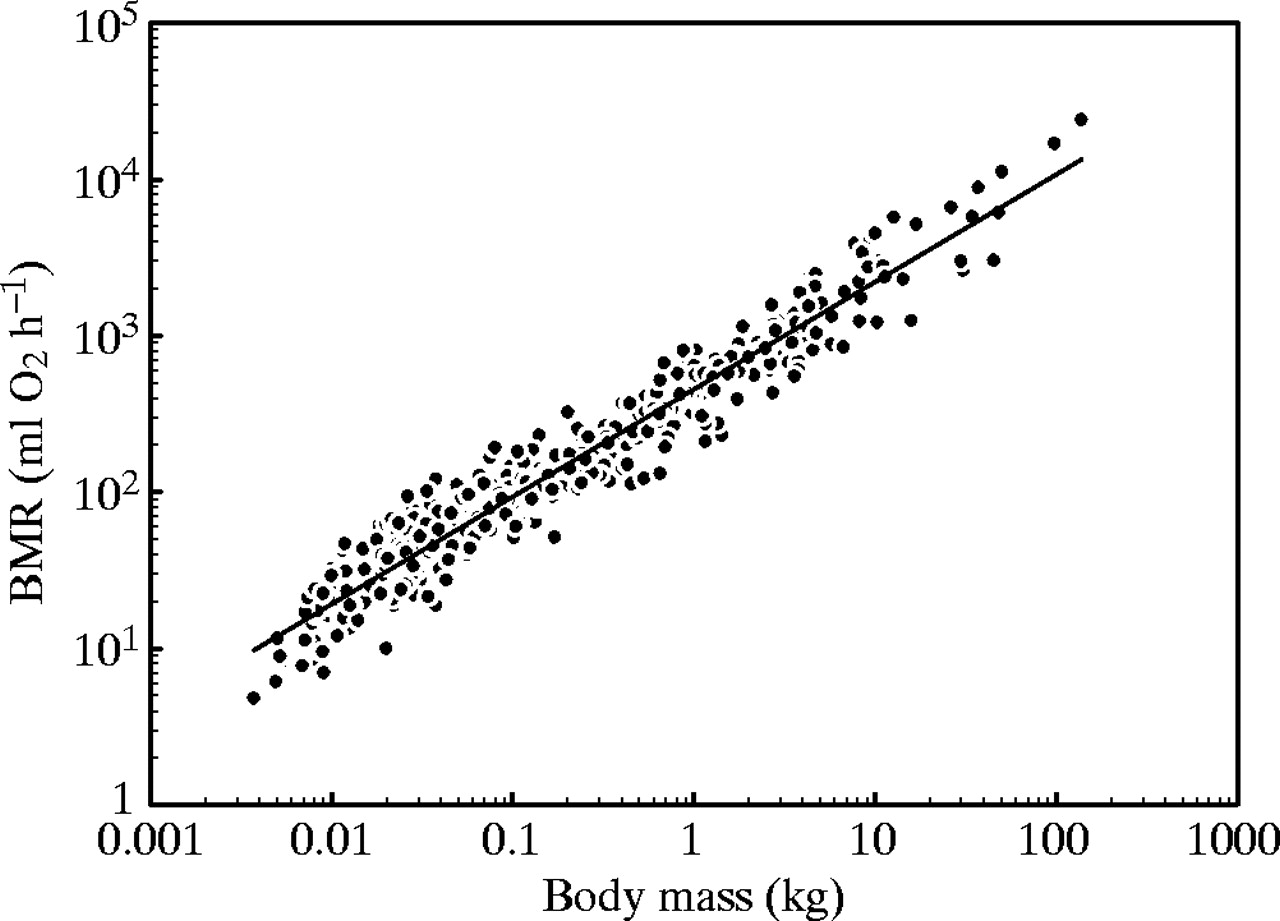
Twenty years later, Geoffrey West and his collaborators used this fractal model to explain the well known "3/4" law of metabolism, in which different organisms' resting metabolic rate varies as the 3/4 power of their body mass. West, an erstwhile theoretical physicist from Los Alamos who recently stepped down as the head of the delightfully eclectic Santa Fe Institute (for which I've done some writing), used similar scaling analyses of things for other aspects of biology as well as resource usage in cities.

Unfortunately, according to Peter Dodds at the University of Vermont, the well known 3/4 law is also wrong. In my latest story for Physical Review Focus, I briefly describe how Dodds uses a model of the branched network to derive an exponent of 2/3.

Interestingly, this 2/3 exponent is precisely what you'd expect from a simple computation of the surface to volume ration of any simple object. A 2/3 law for metabolism was first proposed in the mid 1800s, Dodds said, at "a tobacco factory in France, trying to figure out how much to feed their workers, based on their size. They asked some scientists and they said 'we think this 2/3 rule would make sense.'" Experimental data on dogs seemed to fit this idea.

But later experiments hinted at a slightly higher exponent. "At some point it became more concretely ¾," Dodds said, based on the work of Max Kleiber published in 1932. "He'd measured some things that looked like 0.75 to him. You know, he had nine or ten organisms, and it was easier on a slide rule." At a conference in the 1960s, scientists even voted to make 3/4 the official exponent.

But in the wake of the fractal ideas, Dodds and his collaborators re-examined the data in 2001. "What really amazed me was I went back and looked at the original data and it's not what people thought. People had sort of forgotten about it by that point." Instead, Dodds, found, the data really matched 2/3 better. At the very least, the 3/4 law was not definitive. This doesn't mean that the fractal description is not useful, only that it has a different connection to the metabolic rate.


From C.R. White and R.S. Seymour, Allometric scaling of mammalian metabolism, Journal of Experimental Biology 208, 1611-1619 (2005). BMR is resting metabolic rate. The best fit line has a slope (exponent) of 0.686±0.014 (95% CI), much more consistent with 2/3 than with 3/4.

Other authors have since supported this conclusion, especially if they omit big herbivores like kangaroos, rabbits, and shrews, whose resting metabolism is hard to measure. The real biological data is messy, and perhaps it is silly to expect a simple mathematical law to apply to diverse biological systems. In any case, the difference between the two exponents is modest, amounting to a factor of about 2.5 in metabolism over the range of experimental data in the plot.

Still, some experts, such as the commentators that I interviewed for the Focus story, still think that the 3/4 law is correct. But it seems plausible that many decades of experimental observations have been colored by researchers' expectations. Science remains a human endeavor.

Wednesday, February 3, 2010

Beautiful Data

There's an old joke where a scientist presents "representative data," when everyone knows it's really their best data. Like many jokes, there's a large measure of truth in it. (And like many science jokes, it's not actually funny unless you're a scientist.)

Audiences, whether in person or in print, like a good story. And it's best when data tell a story on their own, without further words of explanation. Scientists can handle tables of numbers better than most people, but, even for them, pictures tell the most compelling stories.

In fact, many experienced researchers begin preparing a new manuscript by deciding what figures to include. In part this is because figures take a lot of space in journals, but in addition many readers will go from the title straight to the figures, bypassing even the short abstract. If the pictures don't tell a good story, readers may just move on.

This is what it means when scientists say data are "beautiful": not that they have some intrinsic aesthetic appeal, but that they tell a good story about what's happening. Ideally, the story is compelling because the experiments have been done very well. But that's not always the reason.

Some of the most beautiful data I ever saw, in this sense, were presented at Bell Labs by Hendrik Schön in early 2002, at a seminar honoring Bob Willett and the other winners of that year's Buckley Prize. In contrast to Willett's painstaking work over many years elucidating the properties of the even-denominator fractional quantum Hall effect, Schön presented one slide after another demonstrating a wide variety of phenomena in high-mobility organic semiconductors.

The problem was that the story the beautiful data were telling was a lie. Schön's rise and fall were expertly described in Eugenie Reich's 2009 book Plastic Fantastic, and I was later on the committee that concluded that he had committed scientific misconduct.

But honest scientists also must be careful when they choose data that supports the story they want to tell. There is an intrinsic conflict of interest between telling the most compelling story and facing honestly what the data are saying. Decisions about which data to omit, and how to process the remainder, must be handled with great care.

As a rule, scientists overestimate their objectivity in selecting and processing data. As individuals, they are more swayed by expectations than they would like to admit. Collaborators can help keep each other honest, but only to a degree.

One thing that keeps science on track in these situations is that other people may make the same sort of measurements. Often different experimenters have a different idea of what's right, and the back-and-forth helps the field as a whole converge toward the truth.

But what happens when a whole field expects the same thing? There's a real danger that the usual checks and balances of scientific competition will break down, and all the slop and subjectivity of experiments will be enlisted in service of the common expectation.

Just because data is beautiful--that is, tells a good story--doesn't mean that story is right.

Tuesday, February 2, 2010

Tunable Flexibility

Some genes can't be substantially changed without fatal consequences, while tweaking other genes lets organisms gracefully adapt to new situations.

This modular organization, in which some groups of components maintain a fixed relationship to one another even as the relationship between groups changes, is common in biology. In their book, The Plausibility of Life, Marc Kirschner and John Gerhart argue that the weak linkages between unchanging modules are a critical ingredient of "facilitated variation," which in turn makes rapid, dramatic evolution possible. But this long-term adaptability may be, in part, a fortunate side effect of a system that lets individual organisms respond to changes during their lifetime.

Natural selection is not based on compassion. It would be reasonable if both essential genes--those within modules--and nonessential genes--including those forming the weak linkages between modules--mutated equally readily. A mutation within a module might kill its host, but that's the way of progress. Mutations of the linkages could survive, and, by altering the relationship between modules, allow a population to explore new innovations.

Evolution would be more efficient if genes within modules didn't mutate as quickly as those between them. But it's not required.

But what if the evolvability is just one facet of a more general flexibility? At a December 2009 meeting in Cambridge, MA, which I'm covering for the New York Academy of Sciences, Naama Barkai of the Weizmann Institute in Israel showed evidence that genes that evolve rapidly also show greater variability in expression.

To measure the rate of evolution, Barkai's postdoc Itay Tirosh compared different yeast species to see which genes had the most differences. Some genes differed a lot, while others were quite similar.

Tirosh also looked at two measures of the intrinsic variability of gene expression (measured by messenger RNA levels): the degree of change in response to changed conditions, like stress, and the time-dependent variation in expression, or noise. Again, some genes varied a lot, while others stayed quite steady. Moreover, the variable genes were likely to be the same ones that evolved rapidly.

These three correlated measures of gene flexibility were connected with differences in the structure of the promoter, which is the region of DNA near where its transcription into RNA begins. Flexible genes tended to include the well-known "TATA" sequence of alternating tyrosine and adenosine bases, as well as different arrangements of the nucleosomes.

A complete understanding of the role of flexibility in both short- and long-term variation will require a lot more research. But these results support the notion that arrangements that let organisms adapt to the slings and arrows of everyday life also give them the tools to rapidly evolve dramatically new ways of life.

Friday, January 29, 2010

Fusion on the Horizon?

When I arrived at MIT in 1976, fresh off the bus from Oklahoma, nuclear fusion looked like an exciting scientific career. The country was still reeling from "the" energy crisis (oil was over $50/barrel in today's prices!), and fusion was the energy source of the future.

It still is.

The promise has always been compelling, and is often described as "unlimited pollution-free energy from seawater." The fusing of two hydrogen nuclei to form a helium nucleus, releasing abundant energy without the radioactive products of nuclear fission, certainly seems cheap and clean. Indeed, this kind of process is the ultimate source of all solar energy as well, and the H-bomb showed that we can create it on earth.

So the challenges for fusion are not fundamental. They're "just engineering."

Foremost among these challenges is keeping the hydrogen nuclei together when they're heated to millions of degrees. This temperature is needed so they can overcome their natural electrical repulsion, but when they have a lot of energy they're just as likely to go in other directions. Sadly, techniques to confine these tiny nuclei seem to require tons and tons of expensive, high-tech equipment. Of course, advocates of cold fusion, now called "Low Energy Nuclear Reactions," think they don't have to solve this problem, but most scientists are unconvinced.

The traditional approach to fusion, then being pursued at MIT, involves confining a donut-shaped plasma of ultra-hot charged particles by using an enormous magnetic field. One problem is that the plasma finds all sorts of ways to wiggle out of the confinement. Over the decades, researchers have made steady progress in controlling these "instabilities." Recent research, still done at MIT and published online in Nature Physics this week, used a surprising technique of levitating a half-ton magnet in mid-air.

The other mainstream approach is to squeeze and heat hydrogen-containing materials by blasting a pellet with powerful lasers from all sides. Research at Lawrence Livermore's National Ignition Facility, published online in Science this week, showed promising results for this approach.

I've always found the idea of milking a steady stream of power out of occasional explosions inside of a horrendously expensive, delicate laser apparatus confusing. In fact, the long-defunct radical magazine Science for the Peoplepublished an article in 1981 claiming that "inertial confinement" fusion was just a plot by the military to test fusion explosions in the lab. That at least made sense.

The new results seem like steps forward for both approaches, but there's a long way to go. For one thing, neither group actually fused anything. They just set up conditions that seemed promising.

The reality is that no researchers want to actually use fusion-capable fuel in their machines, because it would make them radioactive (the machines, not the researchers). This may sound surprising, since fusion is supposed to be so clean. But although fusion doesn't produce radioactive nuclei, it does make a whole lot of high-speed neutrons. To generate power, researchers would need schemes to extract the energy from these neutrons. But the neutrons also irradiate everything in sight, turning much of the apparatus into hazardous waste, which would make experiments much harder.

But if the researchers keep making progress, they're going to have to use the real stuff soon. They'll look for any fusion at all, and eventually for "scientific breakeven," where they get more energy out than they use to power all the equipment. "Commercial breakeven," where the whole endeavor makes money, is much further down the road.

I wish the researchers good luck; they may yet save our planet. But I'm also glad I didn't decide to spend the last third of a century working on fusion.