Showing posts with label nano. Show all posts
Showing posts with label nano. Show all posts
Tuesday, September 25, 2012
September 25, 2002
Ten years ago today, Lucent Technologies released the Final Report of our committee on possible misconduct by J. Hendrik Schön. The conclusion was clear: that there had been extensive misrepresentation and, by implication, that the entire body of work was suspect.
Actually, the report had been largely finished for a while, but Lucent wanted a chance to have their lawyers and management check things over. This was a small price to pay to have the report publicly released in full. Remember that they had no legal obligation to release anything, but they released everything.
The response to the report was very gratifying. Although there had been until then some holdouts who felt that the investigation might be some kind of witch-hunt, the extensive documentation that we provided of the many instances of misconduct assured that virtually no one maintained that belief afterwards.
In spite of this sense of satisfaction and closure, however, we took no joy in delivering that verdict.


Thursday, May 24, 2012
May 24, 2002: What got the Schön investigation going?
Leading into the spring of 2002, there had been increasing discomfort with Hendrik Schön's stunning body of scientific results. The official investigation into his possible misconduct, however, only began when a group of nano-physicists noticed duplicated data in five papers. As described nicely in Eugenie Reich's book Plastic Fantastic, Lydia Sohn (then at Princeton), Paul McEuen, Leo Kouwenhoven, and Charleses Marcus and Lieber sent their findings to the Bell Labs management and to the journals where the articles were published at the beginning of May. It is interesting to speculate whether and how the investigation would have proceeded if it had been communicated less publicly.
During this period, a PowerPoint version of the slides was widely circulating in the nano community. The usual technique was to print out the graphs on transparencies and line them up, but I include them here as animated gifs for a change of pace. The figures show very similar curves, even though the data are represented as being taken from completely different samples. In principle this could happen once through gross negligence, by sending the wrong figure (with the wrong label!). In addition, however, the axes are sometimes differ in sign or by an integer multiplier, or they have some curves missing, which are much harder to understand. But the most damning evidence is that the small deviations from the curves are often very similar in different plots, even though this "noise" should vary each time the measurement is repeated.


For many researchers, seeing these images was all the evidence they needed that Schön had fabricated at least some of his data. Others held out hope that there was some innocent explanation, and looked to our "blue-ribbon panel" to resolve the issue. We on the committee felt a lot of pressure to get it right. But by this time ten years ago, we still hadn't yet gotten any detailed documentation from Lucent.
During this period, a PowerPoint version of the slides was widely circulating in the nano community. The usual technique was to print out the graphs on transparencies and line them up, but I include them here as animated gifs for a change of pace. The figures show very similar curves, even though the data are represented as being taken from completely different samples. In principle this could happen once through gross negligence, by sending the wrong figure (with the wrong label!). In addition, however, the axes are sometimes differ in sign or by an integer multiplier, or they have some curves missing, which are much harder to understand. But the most damning evidence is that the small deviations from the curves are often very similar in different plots, even though this "noise" should vary each time the measurement is repeated.


For many researchers, seeing these images was all the evidence they needed that Schön had fabricated at least some of his data. Others held out hope that there was some innocent explanation, and looked to our "blue-ribbon panel" to resolve the issue. We on the committee felt a lot of pressure to get it right. But by this time ten years ago, we still hadn't yet gotten any detailed documentation from Lucent.
Wednesday, May 23, 2012
May 21, 2002: Investigating the Schön Affair
Ten years ago this week, Lucent Technologies announced that it had convened a panel to investigate possible scientific misconduct at Bell Labs. Interestingly, the story in the New York Times by Kenneth Chang featured the role of Bertram Batlogg, mentioning Hendrik Schön only in the final paragraph.
At the time, I thought this story missed the point, since it seemed clear that Schön was at the center of the problems. (Batlogg wasn't even an author on some of the papers in question.) But as Chang told me later, Batlogg had been highly visible when the spectacular "breakthroughs" were being announced. For this reason, Chang (who had covered the earlier work) thought that Batlogg's was the name that readers would be most likely to recognize, and not highlighting it would be a disservice to readers.
One of the biggest challenges to the committee (which I served on) was figuring out how to deal with Batlogg's role, neither assigning him primary responsibility nor minimizing his role.
At the time, I thought this story missed the point, since it seemed clear that Schön was at the center of the problems. (Batlogg wasn't even an author on some of the papers in question.) But as Chang told me later, Batlogg had been highly visible when the spectacular "breakthroughs" were being announced. For this reason, Chang (who had covered the earlier work) thought that Batlogg's was the name that readers would be most likely to recognize, and not highlighting it would be a disservice to readers.
One of the biggest challenges to the committee (which I served on) was figuring out how to deal with Batlogg's role, neither assigning him primary responsibility nor minimizing his role.
Friday, October 9, 2009
Deadly Mutant Bugs from Space!
Do we have a destiny to explore space, or should we leave it to expendable but increasingly capable robots? This perennial debate was inflamed by the recent conclusions of the Augustine Commission that the current budget was woefully inadequate for getting people to Mars.
But what about the science? Last month, NASA released a report describing more than 100 science experiments done on the International Space Station over the past eight years. I was surprised to see that "advances in the fight against food poisoning" were listed first among the accomplishments:
"One of the most compelling results reported is the confirmation that the ability of common germs to cause disease increases during spaceflight, but that changing the growth environment of the bacteria can control this virulence."
I wrote about the original research for Scientific American (subscribers only) in 2007. If this is the poster child for space research, maybe we should stay home.
Don't get me wrong, this is interesting and surprising research. But several aspects of the work deflate its global significance.
First, note the word "confirmation": The researchers had already demonstrated, in labs on Earth, the increased virulence of Salmonella Typhimurium, which causes food poisoning. They did this by building a special chamber to simulate the microgravity environment. It's important to confirm the results in real space flight, but it didn't really show any surprises.
You may wonder why there would be any effects at all from gravity, which is a very weak force. The electrostatic force between two electrons, for example, is more than 1042 times stronger than the gravitational force at the same distance.
Of course, if you fall off a building, gravity is plenty strong. But if a bacterium fell off a building, it would just float away. The strength of gravity is proportional to the mass of an object, and thus to its volume. As nanotechnologists know from painful experience, other forces like surface tension and fluid viscosity--which depend on surface area, not volume--become much more important as things get smaller. For a micron-sized bacterium, these forces are perhaps a million times larger, relative to gravity, than in a meter-sized person. So the bacterium simply can't directly detect the difference between a really tiny gravity force and none at all.
What the bacterium can detect is the flow of the surrounding fluid. Gravity (through convection) is one of many things that helps stir things up. (Growing crystals in this quiescent environment has often been invoked as another reason to do science in space.) So if you construct a special chamber where the other stirring is absent (as the researchers did), then a little gravity makes a difference.
What kind of difference? Some news stories at the time talked about microgravity causing mutations. This is just wrong. What happened was that the new, ultrastill environment switched the bacteria into a new way of expressing the genes they already had, turning some on and some off. This made them more virulent, by a factor of three, to chickens.
Why would this happen? Lead researcher Cheryl Nickersen speculated to me that the ultrastill microgravity environment might resemble the sheltered environment the bacteria ordinarily encounter, for example, in remote nooks and crannies of the digestive tract. The new expression profile could reflect the ordinary switch they make as they move from the rough-and-tumble of the outside world and the churn of the stomach and prepare to do their dirty work.
The researchers found some active genes that are normally associated with formation of the dense mats known as biofilms. Microgravity could help jumpstart this process by switching their expression ahead of time--although that might also make the critters less successful getting to the intestine in the first place.
So low gravity creates a quiescent fluid (which can also be recreated in the laboratory) that mimics normal conditions that cause salmonella to activate its natural program to settle in for the long haul as a biofilm. This is all interesting, and could be useful. In fact, a company called Astrogenix is now touting the space research as a route to a salmonella vaccine, and has sent further missions on the shuttle to test it.
But doesn't it seem like there might be more direct (and cheaper) ways to learn these things?
Friday, September 18, 2009
Visualizing Orbitals
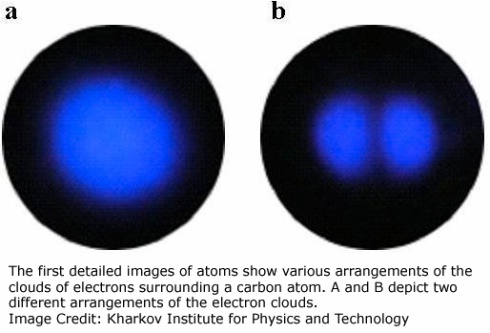
When I was first learning about science, everyone was confident about the existence of atoms but no one ever expected to "see" them. That all changed in the 1980s with the invention of scanning-probe microscopies at IBM Zurich, first scanning tunneling microscopy, then atomic force microscopy and others.
But even in those earlier days, textbooks showed a few pictures of atoms in real space. Those pictures came from a field emission microscope, in which the strong electric field at an ultra-sharp metallic tip rips electrons out of the atoms. Because the field lines diverge rapidly from the tip, the pattern of electrons from different atoms spreads out rapidly until an enlarged version of the atomic arrangement can be directly visualized on a phosphor screen.
Now Ukrainian researchers have adapted this venerable technique in an upcoming paper in Physical Review B to look at the different arrangements of electrons within a single atom. Yes, that looks like s and p orbitals. Yet another thing I never thought I'd see! What a world, what a world.
Subscribe to:
Posts (Atom)


 Posts
Posts


